Hand-painted in oil
About this Artwork
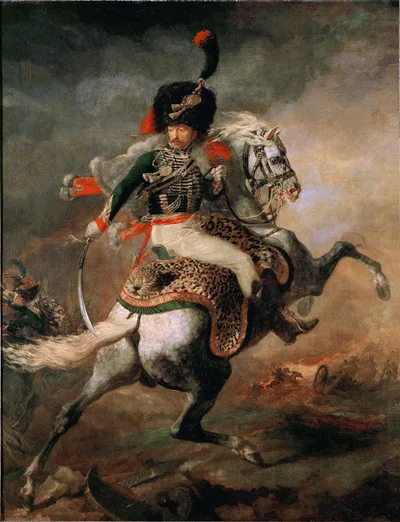
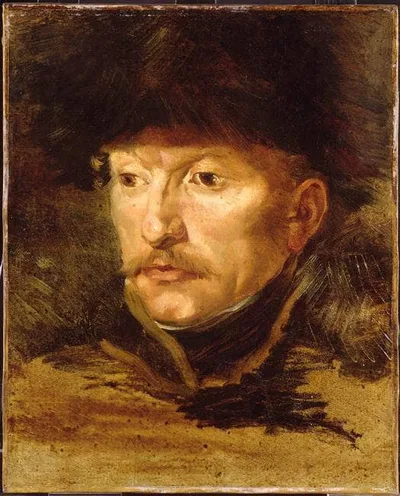
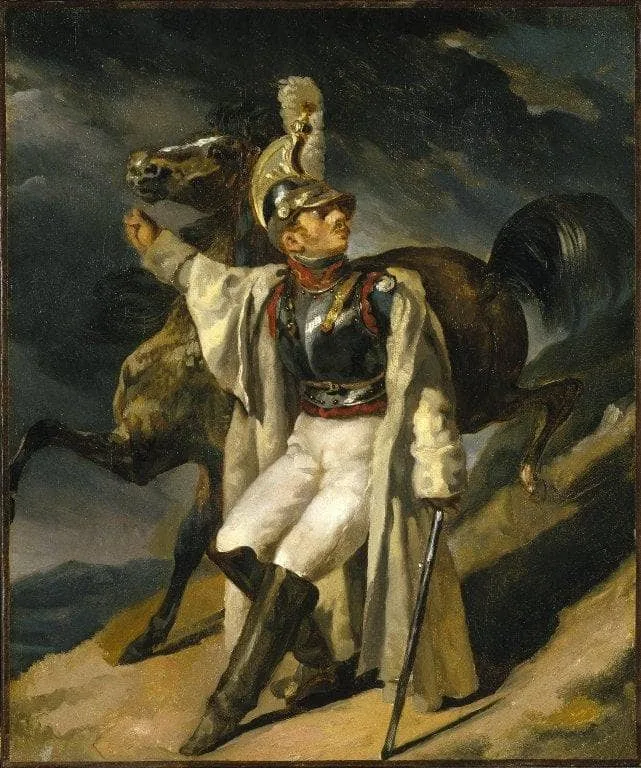
Cavalry after the charge
A cuirassier was heavy cavalry, named for the breastplate, and the class existed to deliver weight at speed. The title of this work takes that machinery and stops it: the man is wounded, and the picture is therefore about a horse at a walk, being led or held rather than driven forward. Within the cavalry category this is the counter-image to the charge, and it is one of the few positions in which the animal's function is not force but support.
What the record holds
The catalogue gives 1814 as the date of creation and the Louvre in Paris as the location. The dimensions are 294 x 358 cm, which is a very large canvas — the scale that history painting and state portraiture used, applied here to a single soldier and his mount. The style term recorded is Realism, the nationality French, and the measured colour family of the image is yellow. The work is filed under male portraiture and Animal Art > Horse.
Scale as an argument
The size is worth reading as part of the subject. Formats of this order were reserved for events, and giving one to a retreating figure rather than to a victory is a compositional decision the record makes visible through its dimensions alone.
Sources
1 references- Géricault, Théodore — Getty ULAN
French painter and draftsman, 1791-1824