
Degas and Racehorses: Before the Start
Published · Art & See editorial desk
Racehorses gave Degas a subject that involved more than speed. The moments around a race also offered arrangements of bodies, riders and intervals. Comparing two identified works shows how a sporting subject can be constructed from both observation and existing images. [1][2]
An early start at Harvard
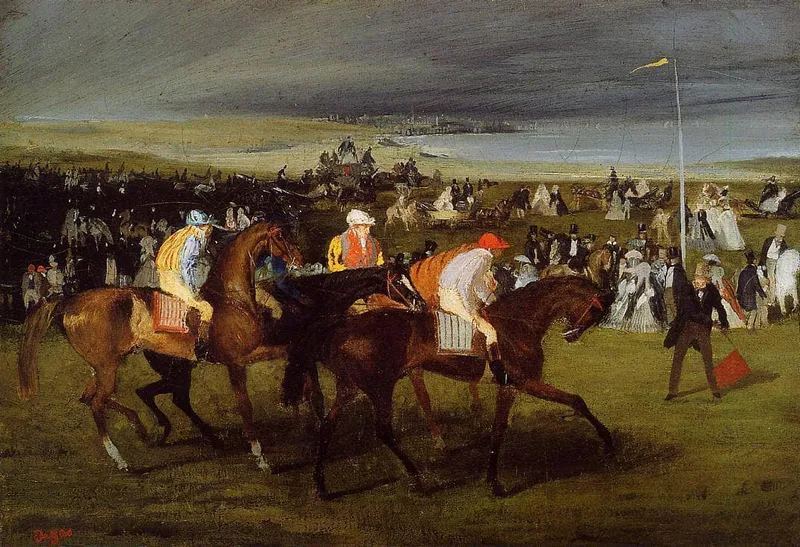
Harvard Art Museums dates At the Races: The Start to about 1860–about 1862. It is an oil painting on canvas, object 1934.30. The museum identifies four jockeys nearing the beginning of a race and explains the differing brown tones as a way of keeping the foreground horses visually distinct. [1]
The approximate date matters. Writing simply “1862” would imply greater precision than the institutional record supplies. The title also identifies this particular canvas; it does not establish that every other Degas work titled At the Races depicts the same group.
Looking for the painter’s models
Harvard’s interpretation connects the early horses with British prints and Géricault. It compares the lifted leg of the horse at the left with a dressage exercise. That comparison concerns the construction of a painted pose, not a claim that the represented event is a dressage competition. [1]
A useful reading begins with relationships: which bodies overlap, which remain separate, and what the spacing lets us see. Describing those decisions is more informative than treating a convincing racing atmosphere as proof that every detail was recorded from a single observed instant.
A later work with older visual sources
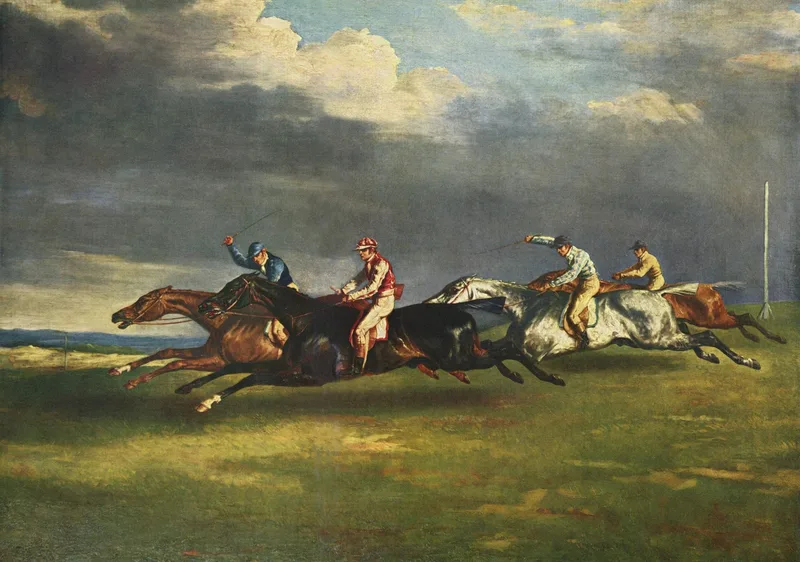
The Met’s Race Horses, about 1885–88, is a pastel on wood, object 1999.288.3. Its catalogue traces the central prancing horse and rider to Benozzo Gozzoli’s Journey of the Magi, which Degas had copied in 1859. The Met also explains that the unvarnished support contributes colour to the landscape. [2]
This comparison challenges a simple progression from “old-fashioned” borrowed poses to pure immediacy. The later image still adapts an earlier artistic model. Differences in support also matter: an oil on canvas and a pastel on wood do not achieve their effects through identical handling. [1][2]


A careful way to compare race scenes
Write down the institution, title, date range and medium for each object before discussing a change across time. Then distinguish the action represented from the models used to make it. A pose copied from another artwork can serve a new sporting context.
Finally, identify which statement is the museum’s interpretation and which is your own visual comparison. Neither a familiar title nor the presence of a jockey supplies a racecourse, a named horse or a particular race result. Leave those details open when the individual record does not establish them.
| Work | Date in the record | Medium and support | Institution and object number | What the catalogue entry adds |
|---|---|---|---|---|
| At the Races: The Start | about 1860–about 1862 | Oil on canvas | Harvard Art Museums — 1934.30 | Four jockeys nearing the beginning of a race; the differing brown tones keep the foreground horses visually distinct; the early horses are connected with British prints and Géricault, and the leftmost horse's lifted leg is compared with a dressage exercise [1] |
| Race Horses | about 1885–88 | Pastel on wood | The Metropolitan Museum of Art — 1999.288.3 | The central prancing horse and rider are traced to Benozzo Gozzoli's Journey of the Magi, which Degas copied in 1859; the unvarnished support contributes colour to the landscape [2] |
Titles, dates, media and object numbers as the two museums publish them. [1][2] Neither entry supplies a racecourse, a named horse or a race result for its picture, so none is given here.