
Hand-painted in oil
About this Artwork
Why the saint is mounted
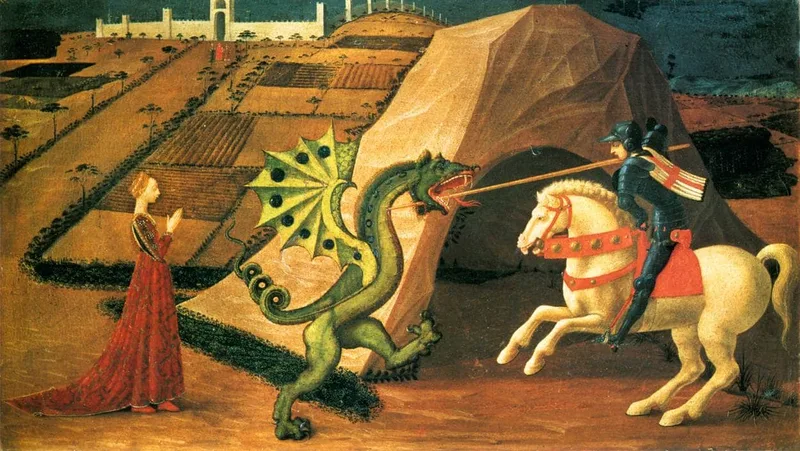
Read as a horse picture, this subject has one governing convention: the dragon is fought from horseback. The mount is not decoration. In the visual language this image belongs to, being mounted is what marks a fighting man as a knight rather than a foot soldier, and it supplies the height and the impetus that a lance attack requires. Strip the horse out and the same figure reads as an infantryman with a spear, which is a different rank and a different kind of victory. Other catalogues will tell you about the saint; what this register records is that the composition is an equestrian combat, built on the same platform as the cavalry pictures elsewhere in these pages.
What the record holds
The catalogue gives 1460 as the date of creation and the Musee Jacquemart-Andre in Paris as the location. The dimensions are 52 x 90 cm, considerably wider than tall, which is the shape used for a narrative panel meant to be read across. Early Renaissance is the style term recorded and Italian the nationality attached to the painter. Landscape, rural, religion, mythology and fantasy categories accompany Animal Art > Horse, and the measured colour families of the image are ochre and yellow.
A caution about the period field
The record's period category reads seventeenth century, which contradicts the recorded date of 1460. Where the two disagree this register follows the date of creation and says that the period field is wrong.
Sources
1 references- Uccello, Paolo — Getty ULAN
Italian painter, 1397-1475