Hand-painted in oil
About this Artwork
A horse that the text does not contain
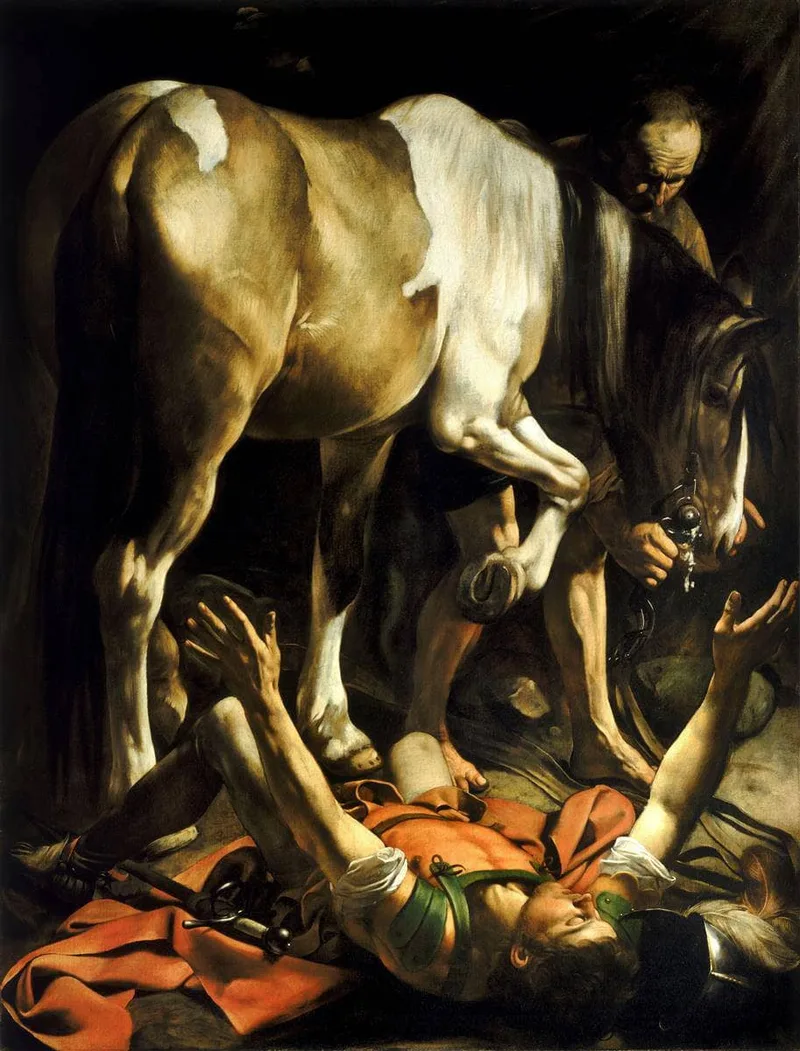
The episode named in the title is the one recounted in Acts, and the account there does not mention a mount. The horse is a painters' addition, and it became the standard way of staging the scene for a practical reason: a conversion is an internal event, and the fall from a horse is the one external action that makes a reversal visible. The animal's function in this picture is therefore narrative rather than military or ceremonial. It is the height the figure falls from. Sites cataloguing the religious subject will read the scene through the episode; read as a horse picture, it belongs with the small class of works in which a fall is the whole composition.
What the record holds
The catalogue gives 1601 as the date of creation and Santa Maria del Popolo in Rome as the location, which places the work in a church rather than a museum. The dimensions are 230 x 176 cm, taller than wide. Two style terms are recorded, Baroque and Tenebrism, and Italian is the nationality attached to the painter. Alongside Animal Art > Horse the record carries religious, mythology and fantasy categories, and the measured colour families of the image are brown and yellow.
What Tenebrism means for an animal subject
Tenebrism names a method of building a picture almost entirely from shadow, with light admitted narrowly. Applied to a scene with a large animal in it, that method tends to make the horse a mass rather than a described creature, and it is one reason pictures in this style resist the kind of detailed reading of tack and conformation that this register applies elsewhere.
Sources
7 references- Caravaggio, Gianni — Getty ULAN
Italian sculptor and installation artist, born 1968
- Caravaggio — Wikipedia
Michelangelo Merisi da Caravaggio (also Michele Angelo Merigi or Amerighi da Caravaggio; 29 September 1571 – 18 July 1610), known mononymously as Caravaggio, was an Italian painter active in Rome for a significant portion of his artistic li
- Caravaggio, Cecco del — Getty ULAN
Italian painter, active ca. 1610-1620
- Conversion on the Way to Damascus — Wikidata
description: painting by Caravaggio; inception: 1600; dimensions: 230 × 175 cm; collection: Santa Maria del Popolo
- beckchris.wordpress.com — record for "Conversion on the Way to Damascus"
Primary source record for this work (beckchris.wordpress.com).
- Conversion on the Way to Damascus — Wikipedia
The Conversion on the Way to Damascus (Conversione di San Paolo) is a work by Caravaggio, painted in 1601 for the Cerasi Chapel of the church of Santa Maria del Popolo, in Rome. Across the chapel is a second Caravaggio depicting the Crucifi
- Conversion on the Way to Damascus-Caravaggio (c.1600-1) — Wikimedia Commons
High-resolution image of the work, hosted on Wikimedia Commons.